


Connections puzzle seem difficult to various players, especially to beginners. Some perceive it as very hard to solve while some perceive it as a bit easy but not a piece of cake. Those who play it regularly know it can be tricky, surprisingly.
You’re given a grid of words and need to divide them into four groups of four based on a common connection. The biggest challenge isn’t always knowing the words. The challenge is avoiding traps, making perfectly reasonable answers look correct when they belong elsewhere.
Therefore it is important for anyone to understand common Connections puzzle mistakes. This can help you spot patterns faster and make fewer wrong guesses. Players can use these strategies to solve Connections puzzle with ease and greater confidence.
What is Connections?
Connections is a word association puzzle in which players get 16 words which is arranged in a 4×4 grid. You have to divide the words into four groups. Each group consists of 4 words. No more than four or fewer than four are allowed.
You have to analyze each word and need to find the common thing between the words. If you can find a common theme connecting 4 words then you will select those words and click on submit. A correct group earns you success, while an incorrect one counts as a mistake.
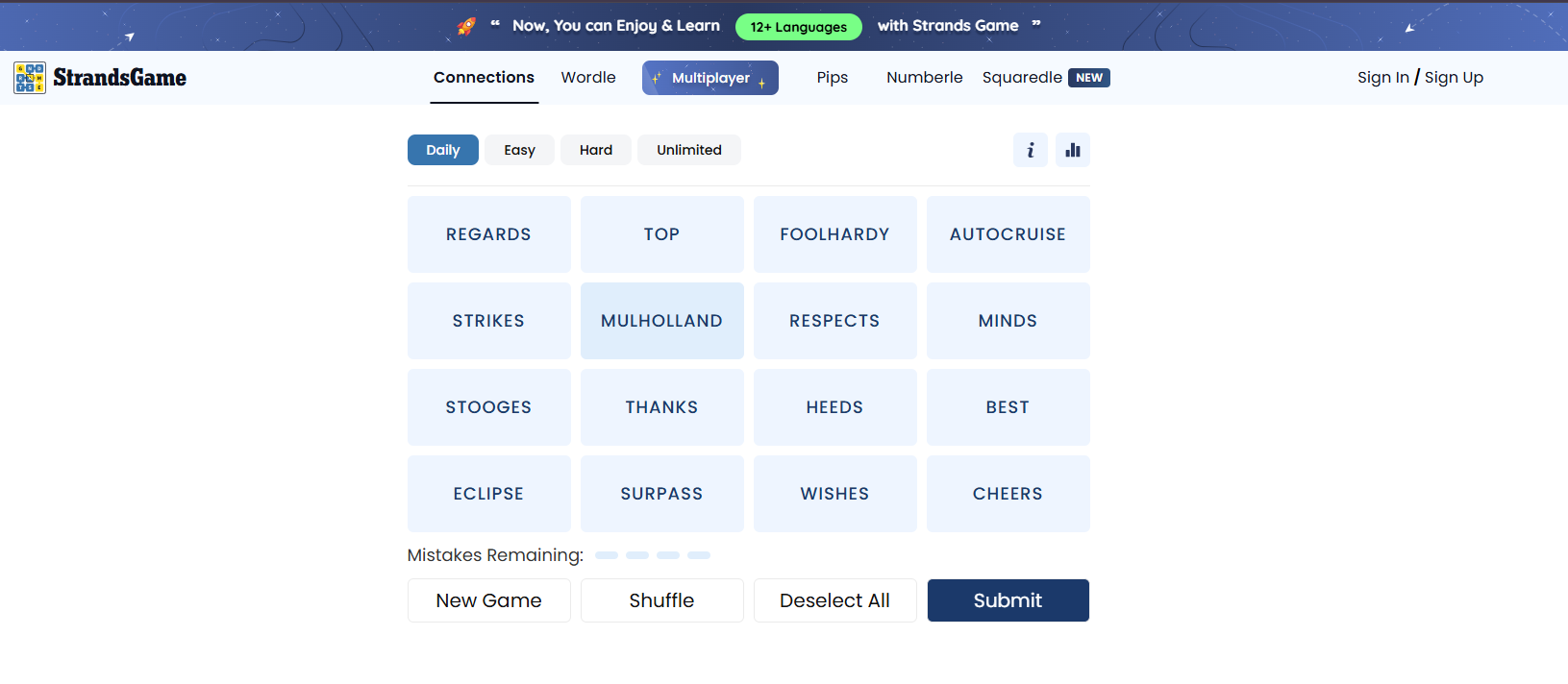
You can make four mistakes only. After four mistakes, the puzzle will automatically become Connections unlimited.
For example, a group contains four words that are all:
Types of fruit
Names of animals
Words that can follow the same word
Movie titles
Famous people
Things associated with a particular topic
The challenge is that some words can appear to fit into more than one group. This is what makes Connections more difficult as you are no longer just finding four related words. So it is important for you to choose a group by thinking carefully.
Why is Connections so Challenging?
Connections rules are basic and easy to understand. However, playing it is a bit tricky. The puzzle challenges you to spot patterns while ignoring misleading clues.
As you know that a word can have several meanings or associations. It can be the name of an animal but also part of a movie title. Suppose the word is train. Now it can either be the connected vehicles that run on a railway or an act of teaching or practicing skills.
The puzzle can include words that feel related even though they are not the intended group. This means that solving this puzzle isn't just about finding similarities. You need to find and play Connections with precision while checking the similarity or common theme between words.
What are Some Common Connections Mistakes?
Some of the common Connections mistakes are as follows:
Falling for Red Herrings
One of the most common mistakes in this puzzle is falling for a red herring. A red herring is a word or group of words that appears to suggest a correct category but is actually there to distract you.
Suppose you see four words that are all associated with food. You will immediately assume you've found a group. However, one of those words may have a second meaning that connects it to a completely different category. The puzzle uses that overlap to make the incorrect group look convincing.
This is what makes Connections different from just finding four related words. The words must share the specific intended relationship, not merely a possible one.
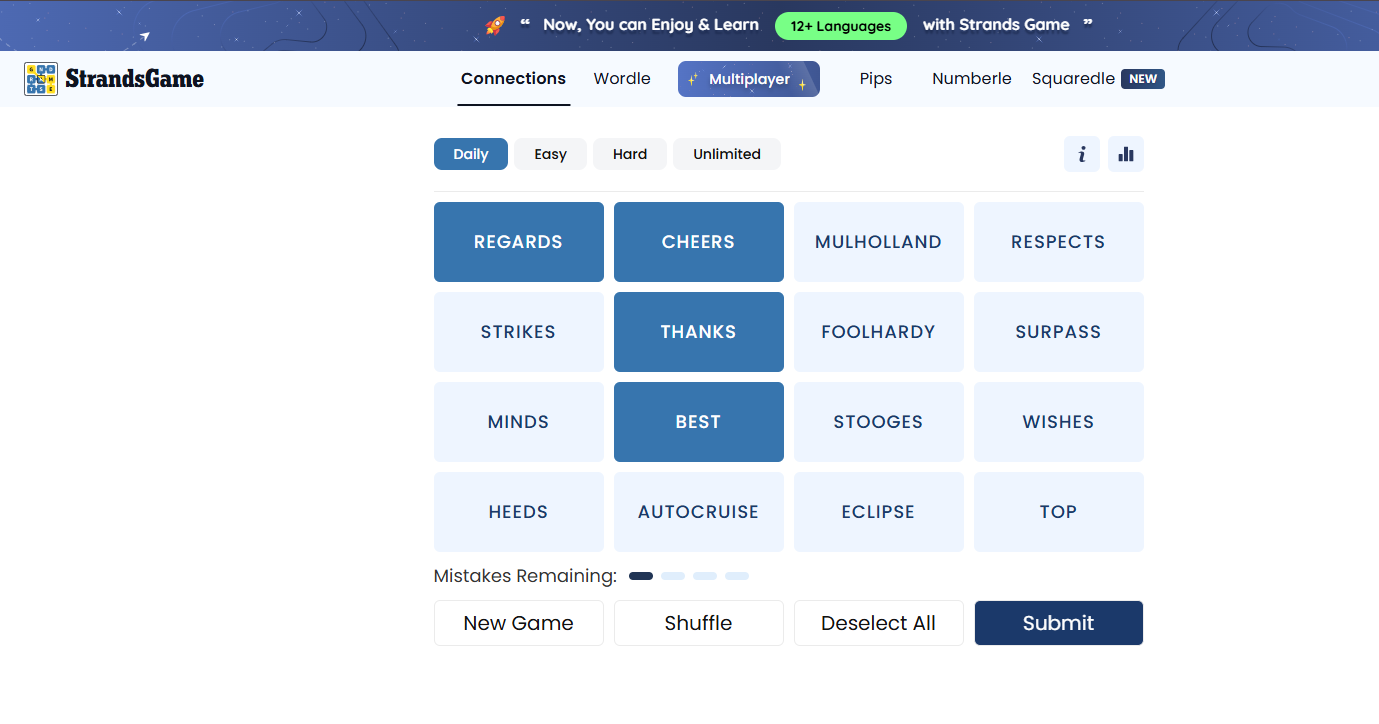
You can see this in the image above as well. The selected letters are the email or ending words and we selected these and clicked submit. This counts as our first mistake.
How to avoid it?
Before submitting a group, you need to take some time to test the Connection. Analyze and think about whether this category is specific enough. Also think about whether another word on the board will fit better.
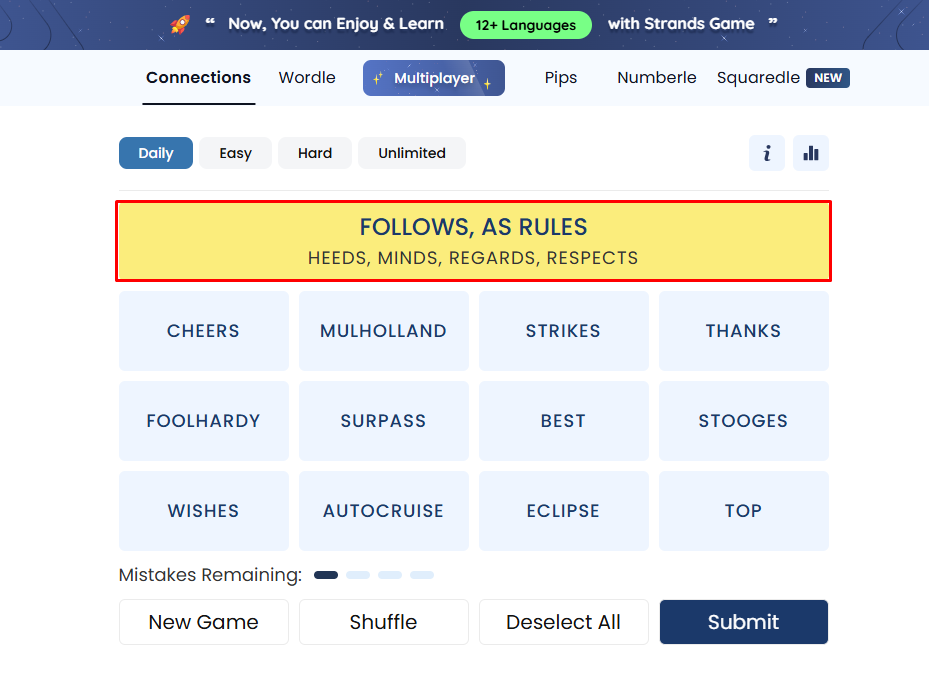
If the words fit several possible categories, take a closer look and search for the most natural connection. Also see if you can connect all four words naturally. You can leave the fewest possibilities for other words.
Focusing Just on One Definition
Another mistake is assuming that the word has only one meaning. The words can have multiple meanings and the same is true in Connections.
Suppose the word is 'light'. It may be referring to the thing which makes everything visible, something that is not heavy or a pale shade of color etc.
If you only think about the most obvious definition, you may completely overlook the intended group.
While playing Connections you may see that an ordinary noun is not related to other nouns or it's not a noun either. The puzzle could be using it because it works as a verb or because it forms a phrase when combined with another word.
How to avoid it?
When you see that a word can’t fit, you need to stop right there and consider its other possibilities. Analyze and think about other definitions, different parts of speech, prefixes or suffixes and any familiar phrase.
Think beyond the first definition that comes to mind. It can reveal connections that initially seem invisible.
Ignoring Board Shuffling
The 16 words in the puzzle are displayed in a 4×4 grid. However, their positions aren't meaningful. A common mistake is focusing too much on nearby words.
Your brain naturally looks for visual patterns. Words placed near each other may seem related, even when their positions are random.
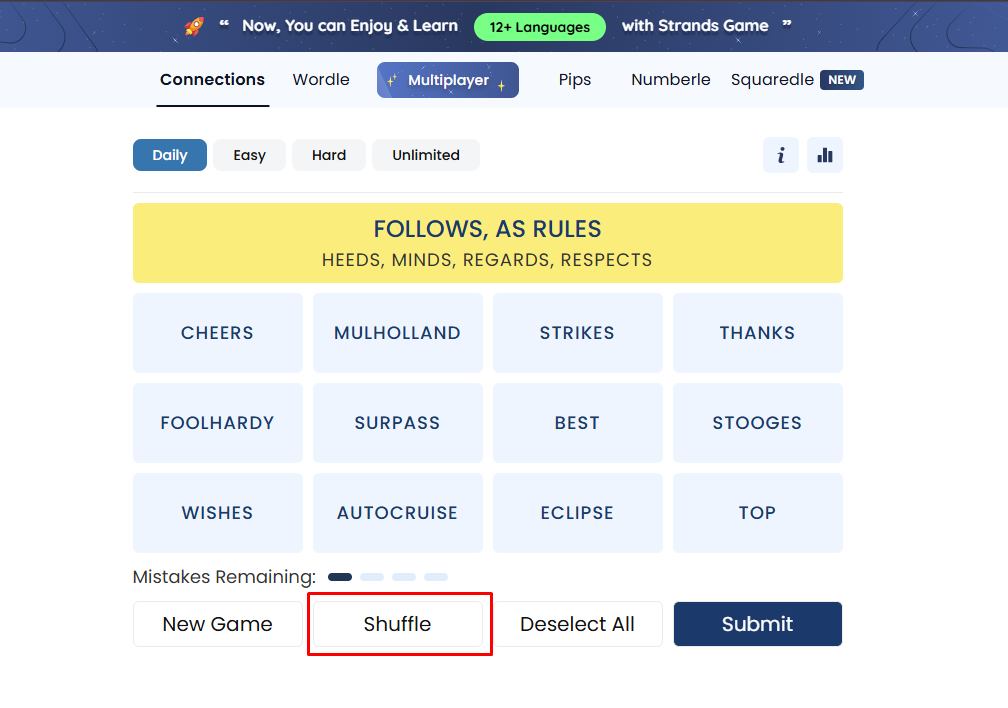
The same problem can happen when you become attached to the original layout. You may repeatedly compare the same words simply because they're near each other, while overlooking a much stronger relationship across the board.
How to avoid it?
Shuffle the board, rather than staring at the rows and columns of the puzzle. Treat it as a collection of 16 individual words. Compare words across the entire board.
It's also helpful to mentally rearrange words into possible categories. Once you find one strong group, remove those words from your mental picture and examine the remaining 12 as a fresh puzzle.
Changing the way you view the board can make hidden relationships much easier to recognize.
Rushing Your First Guess
When you see a possible group and you feel a sense of confidence. You notice four words that seem related. You would want to select them immediately but pause before submitting.
The problem is that Connections puzzle can create these moments of false confidence. A group will look accurate at first but it can contain a word that actually belongs somewhere else.
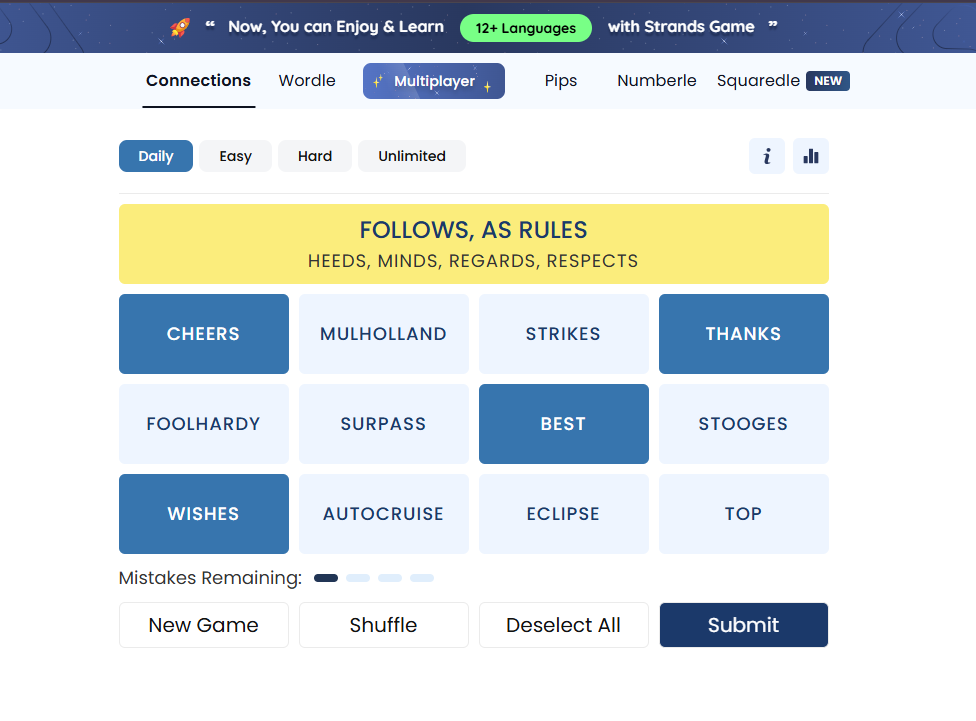
See the above image as an example. Thanks, Cheers, Best and Wishes seem related. However they aren’t.
Rushing through the puzzle can cause you to miss more meaningful connections. You will be stuck with your first idea and start making the rest of the puzzle fit around it.
How to avoid it?
Don't submit a group just because the connection seems possible. Before you submit your first guess, take a few seconds to analyze the other words. Think if this is the strongest possible connection or just the first one you noticed.
If you're unsure about one of the four words, leave the group for later. Sometimes solving another category will make the correct answer obvious. A short pause before your first guess can save you from making a mistake.
Refusing to Write it Down
Trying to solve Connections entirely in your head makes it difficult to track every possible category and combination. This can work when the puzzle is easy. But it becomes much harder when several words have multiple possible meanings.
You will notice one possible group, then another and then a third. By doing so you're trying to remember the words you already considered and the combinations you've ruled out. This mental mess will make a puzzle seem more difficult than it actually is.
How to avoid it?
If you're solving on paper or taking notes, write down your ideas. Don't create detailed notes. You can write the simplest possible categories next to a few words. It can also improve your chances of finding the correct groups.
For example, you mark a word as potentially belonging to "sports," "names," or "phrases." Seeing those possibilities written down makes it easier to compare them and eliminate weaker options.
Writing things down isn't a sign that you're struggling. It's simply another way to organize the information on the board.
Forcing a Fourth Word into a Group
Sometimes it happens that you find 3 related words but you are unable to find the fourth word. This situation really becomes frustrating.
This usually results in players choosing the word that seems closest. It will technically have a connection to the category. However the relationship feels weak or needs a long explanation. That's usually a warning sign.
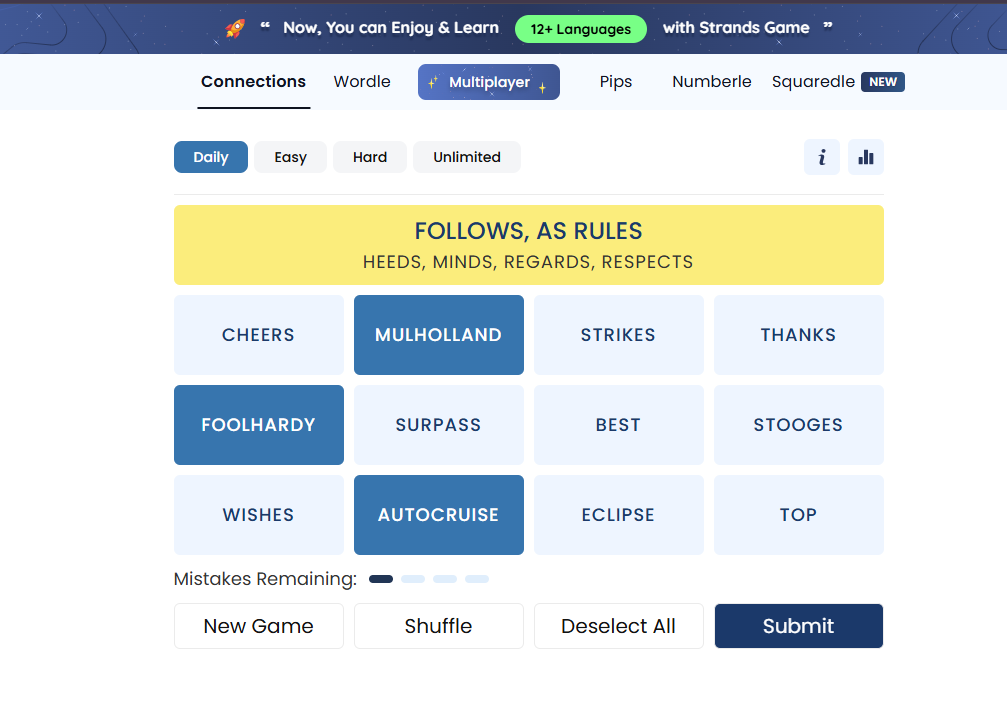
The intended categories tend to have a clear logic. If you have to convince yourself that a word belongs, there's a good chance you've found a misleading group.
How to avoid it?
Don’t force the fourth word. If you find three words that clearly belong together but can't identify the fourth, set the group aside and examine the remaining words. The missing word will become obvious when you find the other groups.
Sometimes you see a three word group and can’t find the fourth but later you come to realise that it was part of another category.
Ignoring the Difficult Words
It's natural to focus on words that immediately make sense. If four words clearly seem related, you will spend most of your time trying to confirm that group. However, the difficult words are usually the most important ones.
If you see a word that seems completely out of place. This word will be chosen specifically because it has an unexpected second meaning. Finding that hidden meaning can unlock an entire category.
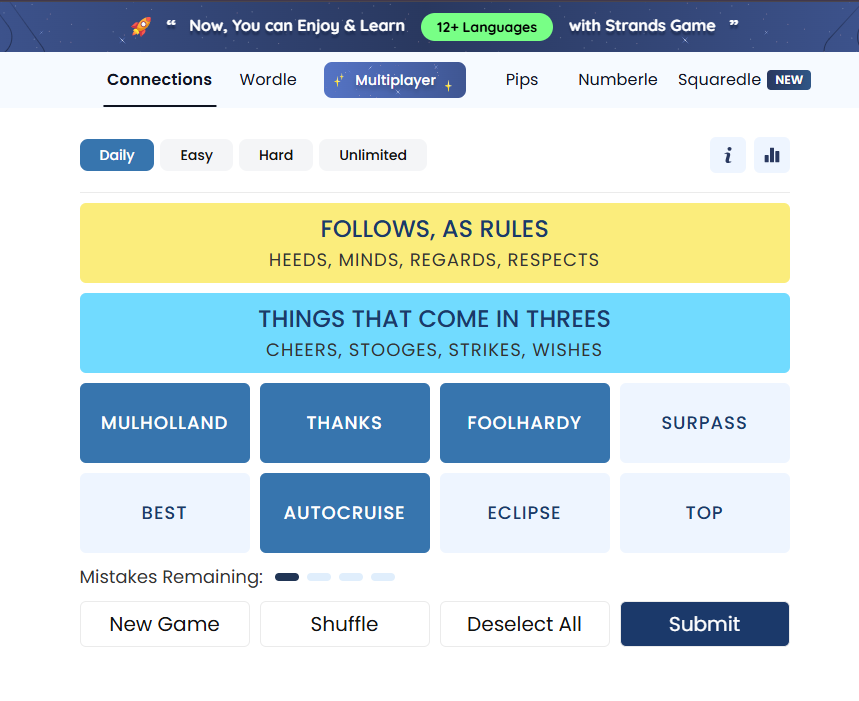
You can see in the above image that the words “Mulholland, Autocruise, Foolhardy and Thanks” may not seem related and may seem difficult. However when you take a closer look, these all connect to the name ‘Tom’.
You need to cut the prefixes off them and only take the suffixes. Now add Tom to them and these make the names of popular actors. Players usually avoid thinking this way.
How to avoid it?
When you're stuck, turn your attention to the words you haven't been able to place. You shouldn’t just be looking for the meaning of the word. You need to ask why you would choose this specific word.
Think about alternative definitions, phrases, names, titles, abbreviations, and cultural references. The strangest word on the board will be the clue you need.
Conclusion
To succeed at Connections, players need more than patience; they also need a good command of words. The best players aren't the people who recognize every category instantly. Successful players know when to question their initial assumptions.
You just need to avoid red herrings, consider multiple meanings, shuffle the board, slow down your first guesses and write down possible connections. Hence the puzzle becomes much easier to solve.
Moreover, don't force an answer just because it looks almost right. If a connection feels weak, pause and look at the board from another angle.
FAQs
Can two groups in Connections share the same theme?
Yes. Two different groups in Connections can share a similar theme. Your goal is to identify four words that share a meaningful connection. It shouldn't rely on loose possibilities.
Should I solve the easiest Connections category first?
When you solve an obvious category first. It will narrow down the board. However, you need to make sure the group is genuinely strong. When you remove the wrong words mentally. It can make the remaining puzzle harder to interpret.
Why do the answers of Connections seem impossible to recognize?
Some categories rely on familiar expressions, names or less common meanings, not on straightforward similarities. These connections can be difficult to spot if you interpret every word literally.
What should I do when several groups seem equally convincing?
Compare the possible groups and identify words that could belong to multiple categories. Choose the group with the clearest connection. You can also postpone uncertain groups until other possibilities become clearer.
Is vocabulary the most important skill for solving Connections?
Vocabulary helps, but it is not the only factor. Recognizing patterns, understanding context and questioning assumptions are also important for finding the intended categories.
How can I improve at Connections over time?
After solving the puzzle, review any categories that surprised you or any guesses that turned out to be incorrect. Understanding why a particular combination worked can help you recognize similar patterns in future puzzles.