


If you enjoy word puzzles that test your vocabulary, logic and ability to spot hidden patterns, Connections is a game worth trying. The puzzle looks simple at first sight but it's not that simple. You will get 16 words and need to divide them into four groups of four related words.
When playing for real, some connections can be surprisingly tricky. But the interesting part is you don’t need to be a vocabulary expert to be the best player.
You have to use the correct strategy to play Connections, as it will help you find patterns faster. You also need to avoid misleading clues and solve puzzles with just a few mistakes.
What is Connections?
Connections is a word association puzzle. In this game you will get 16 words displayed in a grid. You have to find four groups of four words to win this puzzle. Each group shares a common connection.
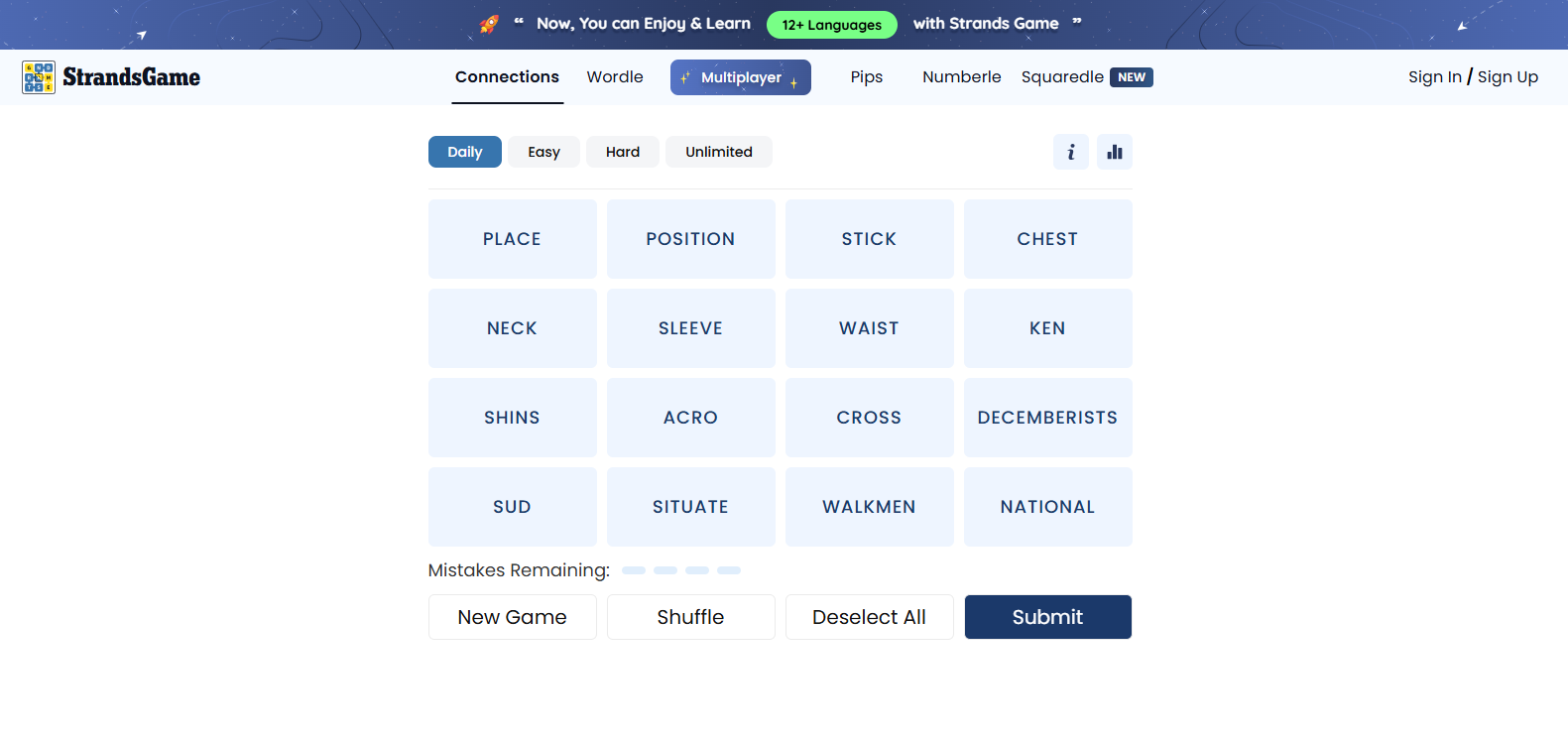
For example, suppose these words: PLACE, POSITION, STICK, CHEST, NECK, SLEEVE, WAIST, KEN, SHINS, ACRO, CROSS, DECEMBERISTS, SUD, SITUATE, WALKMEN and NATIONAL.
The obvious groups will be:
Dress Shirt Measurements: CHEST, NECK, SLEEVE, WAIST
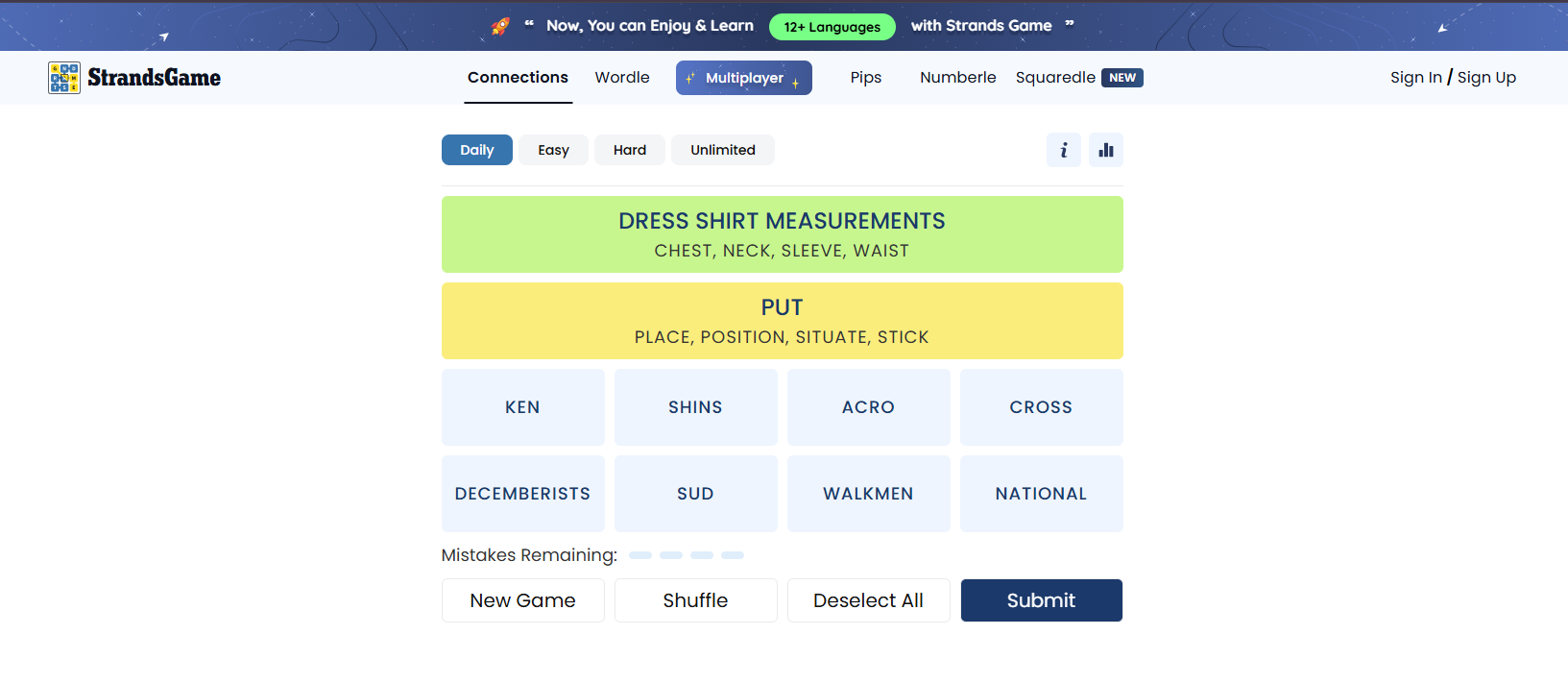
Put: PLACE, POSITION, SITUATE, STICK
2000s Indie Rock Bands: DECEMBERISTS, NATIONAL, SHINS, WALKMEN
NYT Print Puzzles Start: ACRO, CROSS, KEN, SUD
Connections puzzle sometimes become more challenging. This is because words can often fit into multiple possible groups.
Moreover, there are various types available. These are Connections Unlimited, Daily, Easy and Hard. It depends on you to choose the type you want to play.
How to Play Connections?
The basic process is straightforward. Look at all 16 words carefully. Search for four words that share a clear relationship. Select those four words. Submit your guess. Continue until you identify all four groups.
The key is that every word belongs to only one final group. A word can appear to fit several categories. But only one interpretation is correct.
Start With the Most Obvious Connection
When you see the puzzle first. You don't need to immediately try to solve everything at once.
Rather than this, scan the grid for a group. It should be an especially strong connection. If four words clearly belong together, identify that group first.
Removing obvious groups reduces the number of remaining possibilities and makes the harder connections easier to spot.
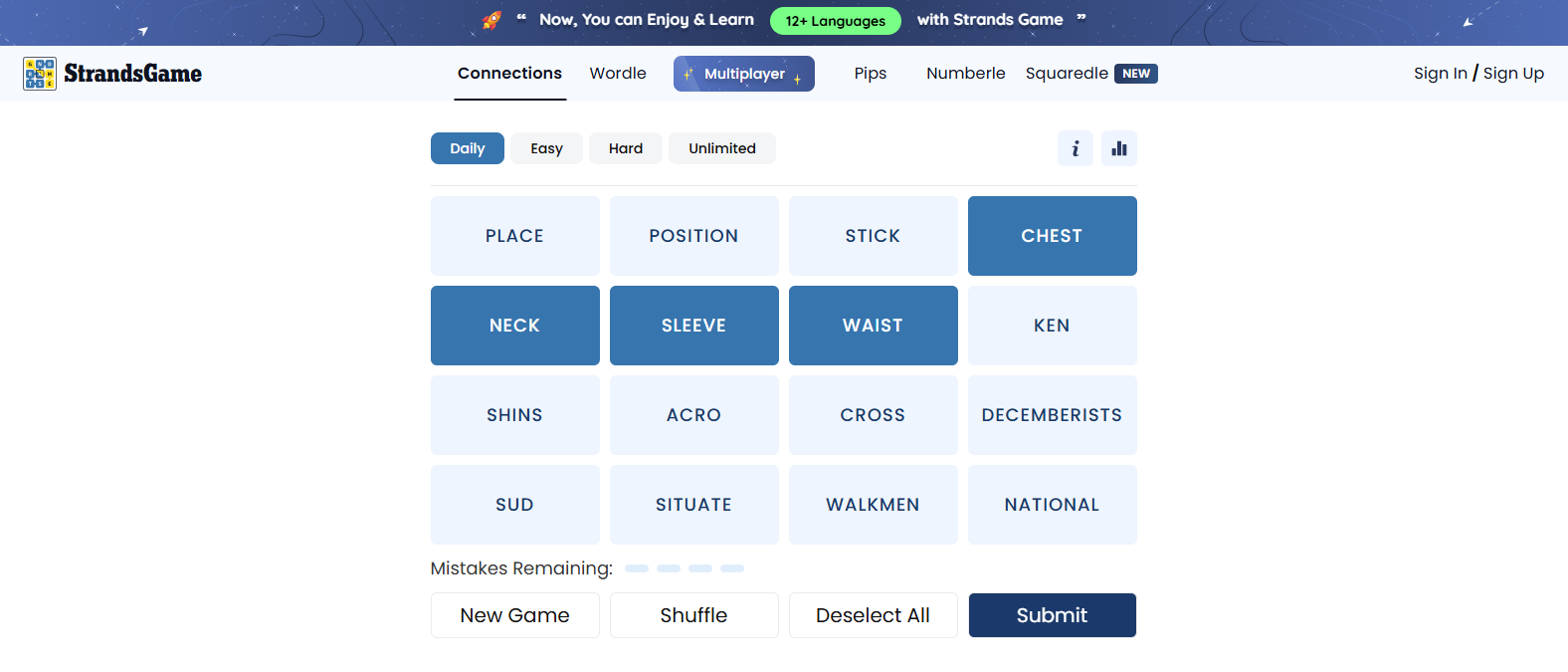
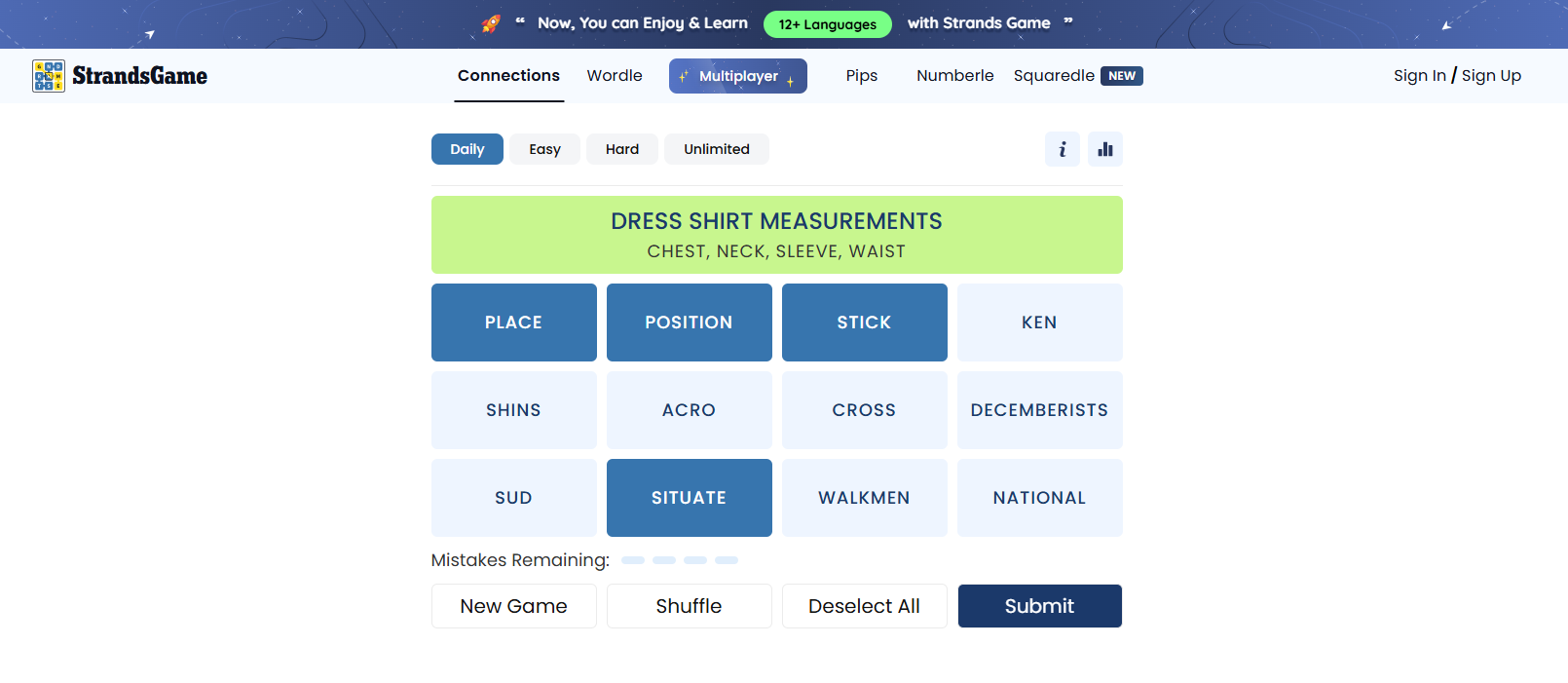
In the above picture, you can see that we have selected 4 words. You can confidently recognize a shirt measurement category. Let's submit it and see what we would get.
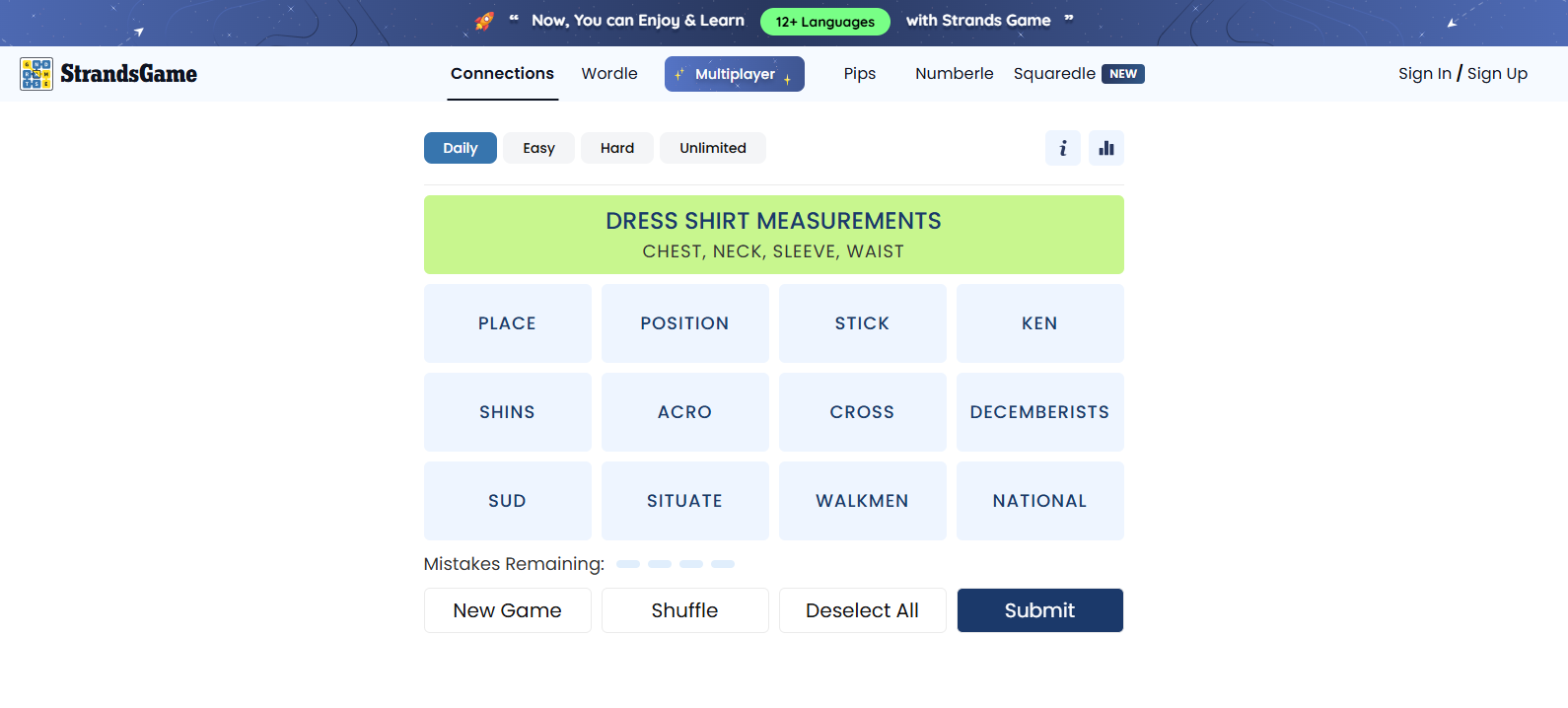
So those words were really the shirt measurements. Keep in mind that you should only select words in Connections when you know the similarities between the words. Or else it will be very difficult and tricky for you to continue playing.
Look for Multiple Meanings
One of the biggest challenges in Connections is that words can have more than one meaning.
A word such as PLACE, for example, could mean to place the book on the table, position/rank, home/building or job/employment. Similarly, a word can be a noun in one group and a verb in another.
Before submitting a group, ask yourself:
"Is each word the best fit for this category?"
This simple question can prevent many mistakes.
Beware of the “Almost Right” Group
Connections puzzles often contain groups that look similar but these are not the intended solution.
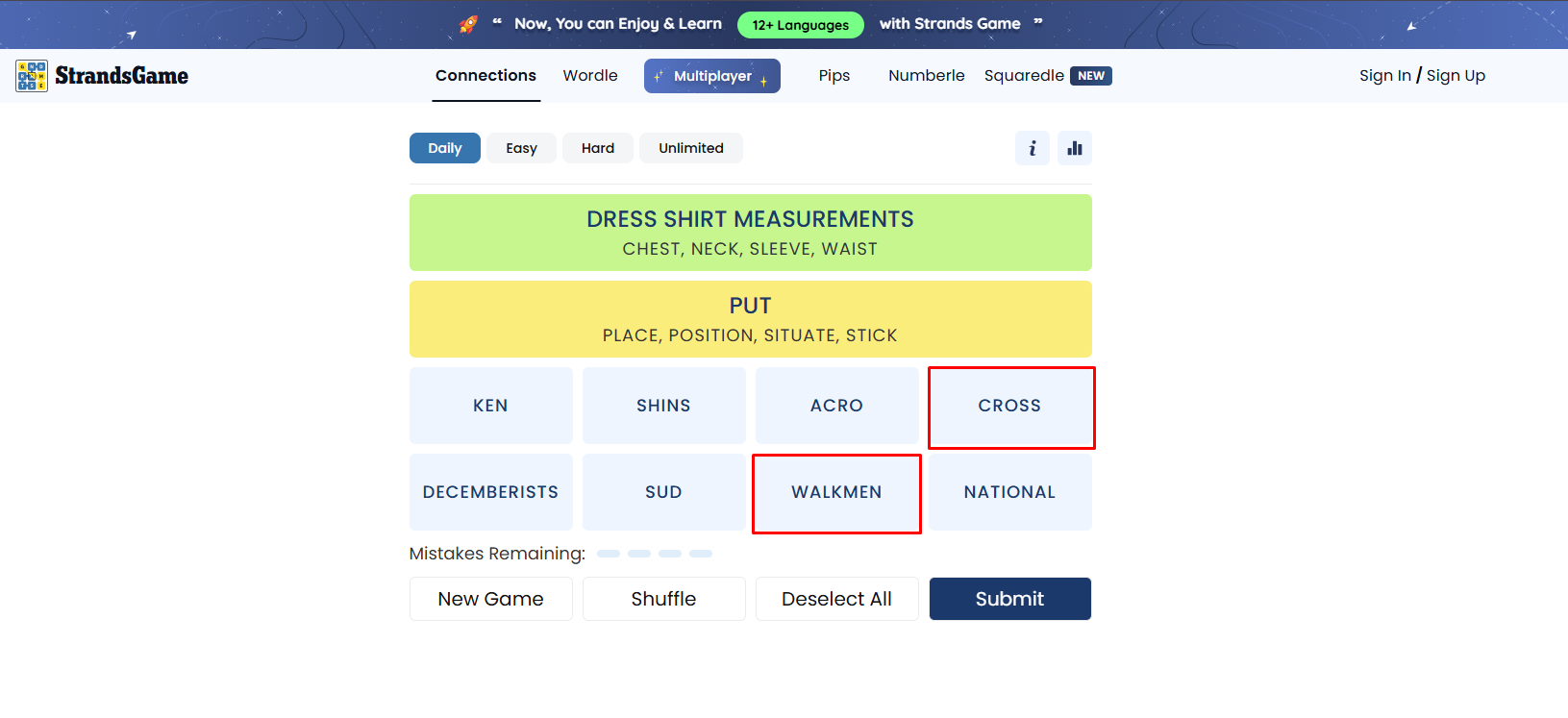
You can find three words that clearly belong together. Then force a fourth word into the category because it seems close enough. Don't do it.
If a fourth word feels significantly weaker than the other three, keep looking. There may be another word with a more precise connection. A good group should generally feel intentional, not forced.
Think Beyond Literal Definitions
Not every connection is based on what a word means. Words can be connected because they follow the same theme, come before the same word, are associated with a particular person, and have the same abbreviation.
It should also contain a hidden word, become another word when a letter is added or removed and relate to a particular category or theme.
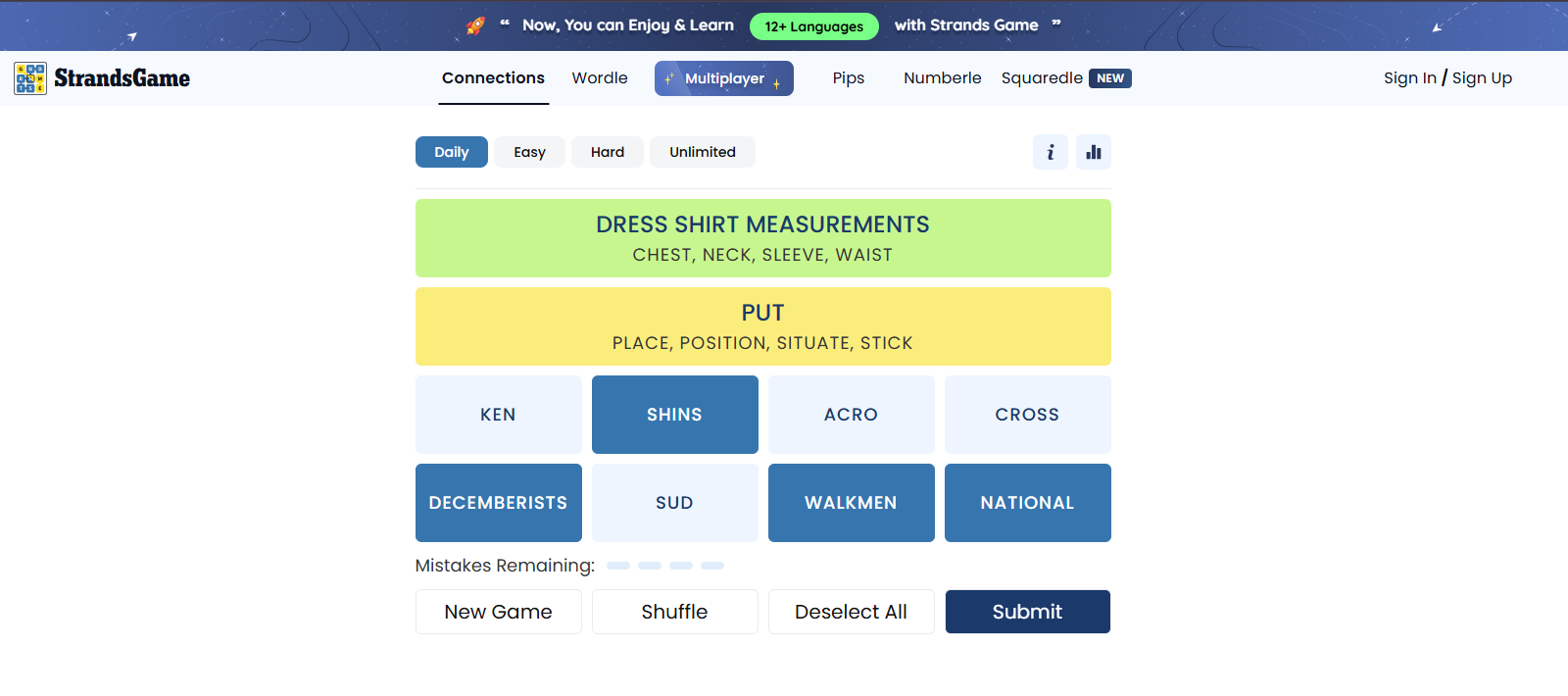
So we connect all these words as they're the rock bands of the 2000s. Let's submit and see what would happen:
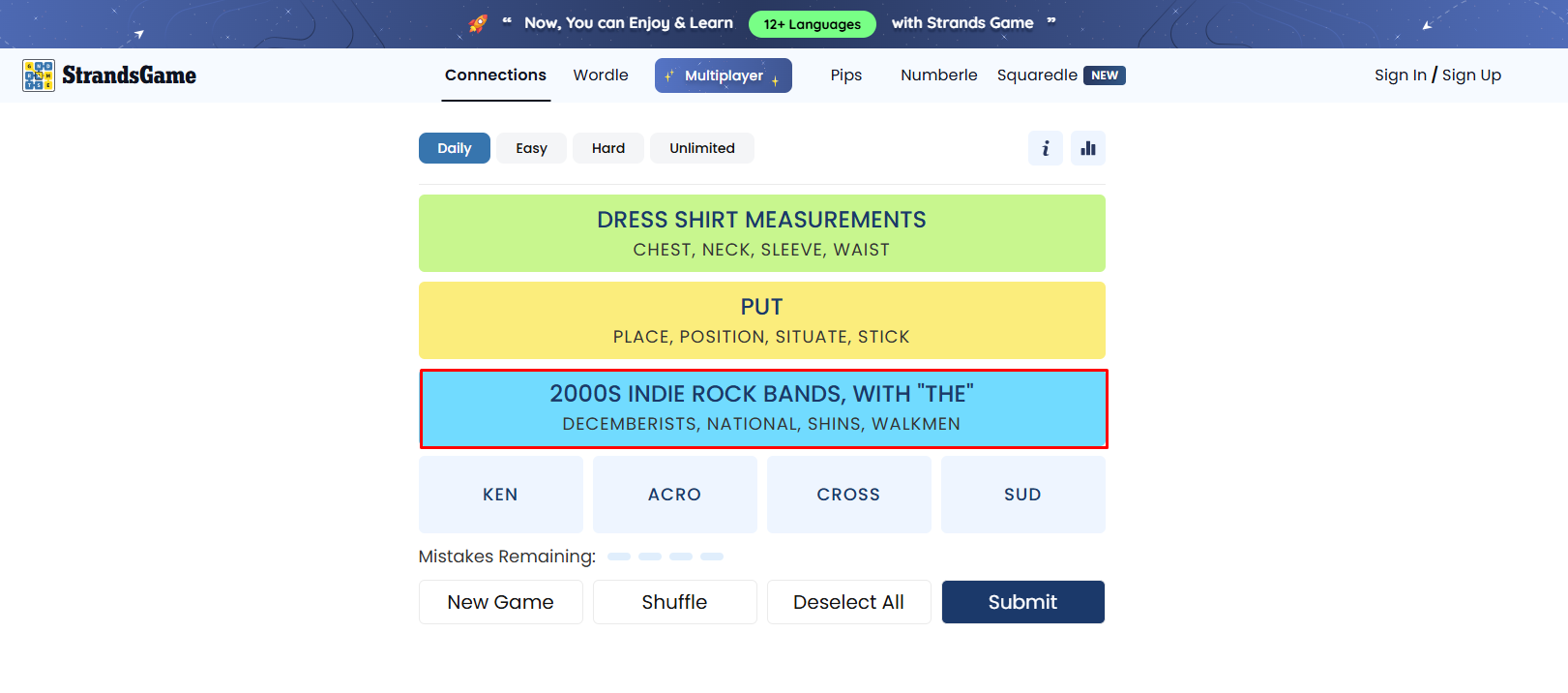
So, this is where Connections becomes a test of flexible thinking and not just simple vocabulary. Beyond that, there are some other educational benefits of Connections: it helps to learn pattern recognition, develops cognitive skills and boosts confidence.
Look for Words That Can Go Together
A useful technique is to mentally place words next to each other. Suppose you see words that can all be preceded by “black.” Instead of considering their individual definitions, consider the phrases they create.
This method can reveal connections that aren't obvious. This is particularly useful for difficult groups.
Don't Commit Too Quickly
If you find three similar words. It doesn’t mean you just found a group. Before submitting, you need to pause. Analyze the remaining words. For example: A, B, C and D can appear to form a category. But D can belong to a different group. E can be the intended fourth word.
Connections reward patience. Sometimes the best move is to leave a promising group alone for some time. You should also see other possibilities.
Process of Elimination
When you find one or two groups. The remaining words will be easy to analyze.
Suppose you already solve eight words. You don’t need to search through 16 possibilities. You're now working with only eight. This minimizes the number of possible combinations.
The process is to identify first, remove, reassess and then solve afterwards. This is the most reliable way to approach difficult puzzles.
Watch Out for Red Herrings
A red herring distracts you from the correct solution. Connections is full of them.
For example, you will see several similar words like types of animals. While one of those words is actually required for a completely different category.
When you find an obvious theme, you don't need to assume that you've solved it. You need to check if the words have any other possible similarity. The strongest similar connection isn't always the correct one.
Consider Different Parts of Speech
Sometimes the connection depends on how a word is used. It doesn’t depend on what that word represents. A word can function as a noun, a verb, an adjective, a proper noun and part of a phrase.
Moreover you also need to try changing the way you use a word. An unrelated word can suddenly make sense. You just need to view it from a different grammatical perspective.
Think About Pop Culture and Everyday Knowledge
Connections aren't limited to dictionary definitions. Categories can involve movies, music, television, sports, famous people and food etc.
You don't need specialized knowledge of everything. However, staying open to different areas of knowledge can help you recognize unusual categories.
How to Improve Your Connections Skills?
Becoming better at Connections is about learning to understand patterns. You need to learn some habits as well.
Expand your vocabulary. Learn common phrases, synonyms, abbreviations and word associations.
Read widely: Books, news, articles and entertainment introduce you to more categories.
Play regularly: Familiarity with common puzzle tricks helps you learn them faster.
Review mistakes: If you can’t find the correct group. Look at why this connection failed.
Think flexibly: Don't limit yourself to words’ definitions only.
When you keep playing it regularly, you'll start noticing connections automatically.
Final Thoughts
Connections are easy to understand but difficult to master. Its real challenge comes from the possibility that a single word can belong to several seemingly logical categories.
The secret is not to rush. Look for strong relationships. Question suspicious groups. Also watch for the same meanings and use elimination when you find the puzzle difficult.
Most importantly, you need to treat every puzzle as a lesson. Even an incorrect guess can teach you how the puzzle's categories are built.
You need to think broadly. Test carefully and don't let the red herrings fool you. This is how you start solving Connections like a pro.
FAQs
How long does a typical Connections puzzle take to solve?
The time depends on the difficulty of the puzzle. It also depends on your familiarity with the categories. An easy puzzle can take only a few minutes. A challenging one requires more time and careful consideration.
Is Connections based more on vocabulary or logic?
It depends on both. Vocabulary helps you understand possible relationships between words. Logical reasoning helps you determine which relationship is actually intended and eliminate misleading possibilities.
Why do connections sometimes feel harder than other word games?
The difficulty comes from uncertainty. Several words can appear to share a relationship even when they belong to different categories. The puzzle therefore requires you to identify the intended relationship. You don’t need to simply find similar words.
Does solving Connections every day improve your skills?
Regular practice can improve your familiarity with word associations, patterns and common puzzle structures. You need to review difficult puzzles. This is specifically helpful as it introduces you to connections you not have considered previously.
What should I do when none of the words seem connected?
When the words don’t seem similar, you need to take a pause from making complete groups. Analyze individual words for alternate meanings, phrases, abbreviations, or less obvious associations. When you change your perspective, you will find a potential category automatically. Sometimes changing your perspective is enough to reveal a potential category.
Is the Connections puzzle always based on the same types of categories?
No. Categories can vary considerably. Some may involve language, while others can draw on entertainment, everyday objects, names, places, or other areas of general knowledge.
What can I learn from getting a Connections puzzle wrong?
An incorrect solution can reveal how your initial interpretation differs from the intended category. Looking back at the unused words and the actual relationships can help you recognize similar patterns in future puzzles.
Can two words have a connection without belonging to the same group?
Yes. This is one of the reasons the puzzle can be challenging. Two or more words may share a legitimate relationship, but the intended solution requires finding the specific set of four that forms the correct category.