





Pips is a wonderful puzzle for people who enjoy solving puzzles. It is a logic-based puzzle that makes you pause and think. It does not pressure your brain with a timer option. It makes your brain work with numbers and patterns. Pips game is all about the right placement of dominoes.
At first glance, the game looks so simple and straightforward. But the more you play, the tougher it will get. But yes, the puzzle, once solved, gives immensely satisfying feelings. You can even take it as a daily mental exercise that improves your cognitive skills.
To quickly solve the pips puzzle, you need to understand the rules completely. That will completely engage you and make you feel delighted with daily pips play.
In this guide, we will explain to you how to play pips and various methods for playing the pips game like an expert.
What is Pips Game?
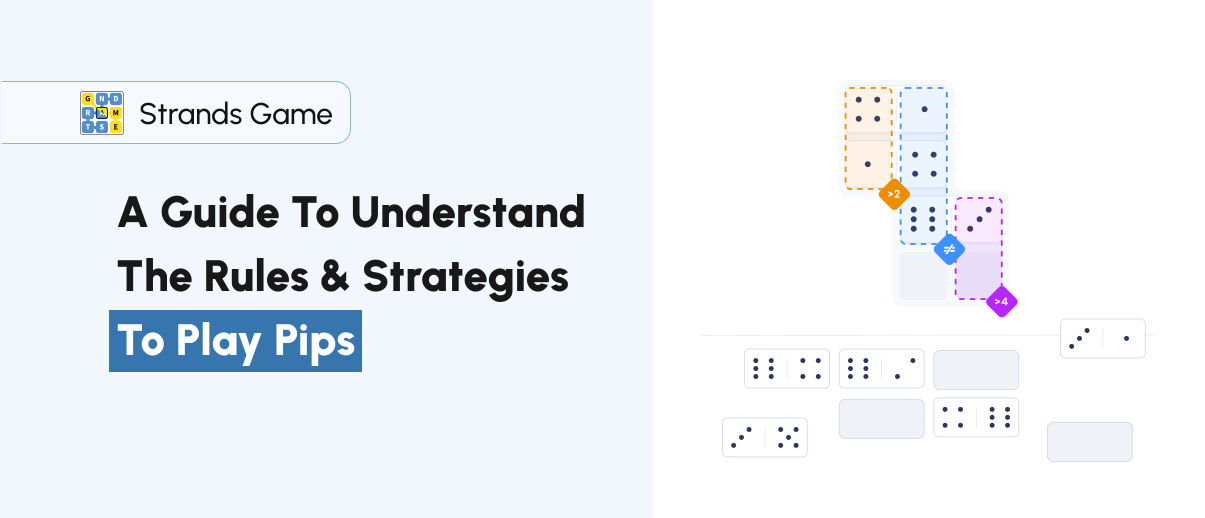
Pips is a game of math and logic in which placing domino tiles strategically is the main objective of the game. The empty grid has different sections with numbers or mathematical conditions.
For example, three parts of a domino area with the number 6 written on it. It shows the domino tiles placed in this region; the sum of the dots must be equal to 6.
Similarly, if there is >7 or <9, the number of dots on tiles in this area must satisfy these conditions. If the domino tiles satisfy these conditions, the puzzle will end. The main challenge in this game is understanding the rules and placing tiles carefully.
Basic Rules of Playing Pips
These are the basic rules for pips players
Use Every Domino Tile
At the start of the pips, you are given a few domino tiles. Each one has two dots on it. Some tiles have empty parts as well. There is no option left. You have to use all tiles to complete the game. No skipping or leaving tiles is allowed.
Understand the Domino tile
Each domino tile covers two squares on the grid. Each square has a particular number of dots. You can place the tile either vertically or horizontally. There is no in-between rotation option. Yes, you can rotate the tile only 90 degrees to fit the condition.
Fill the whole Board
Place all the tiles to satisfy the mathematical condition written on the board. All the spaces must be covered. No gaps or overlaps in tiles are allowed. If one space is empty, the puzzle is not complete. You can not proceed further.
Understand Regional Conditions
These are the most interesting conditions, making the pips challenging and enjoyable. The displayed board is divided into colored sections. Each region has its own rule. For example
- A single domino tile contains two squares, each with the same number of dots or with different numbers of dots.
- The number 10 written on the area means that the tiles placed contain several dots so that the sum is equal to 10.
- = sign means that only those tiles will be placed that have an equal number of dots. If the area covers two square spaces, then a single tile will be enough, but if it is 3 square spaces. One complete tile and half of the other will be placed here. The number of dots on each square must be the same in this case.
- ≠ means the tile placed here should carry a unique number of dots on each square
- > or < means the number of the tile’s dots as a sum should be greater or smaller than the mentioned number
- Space means no number on a domino tile.
- A region with no colour means any number of dots can be placed here. The region is outside the rules of application. Anything can be placed here.
These regional conditions are the foundation of this puzzle. Because of these conditions, the puzzle becomes interesting to play.
Consider two areas conditions at a time
When you place a domino tile in a region, it covers more than one region. So you have to consider both the region section before placing the tile. Both conditions should be satisfied. Place and it does not fit. Replace until the condition meets.
No time Pressure
There is no timer in the game. You can think logically without the pressure of completing the puzzles on time.
Perfectly placing domino tiles wins the game
Pips is not a game of luck or guessing. It is a game of logic. A correct final layout will end the game as soon as you place tiles according to the condition. You win.
Available Difficulty
At the start, when you open up the Pips in Strands game, you potentially see an easy version of pips. As you solve easy puzzles, you will eventually reach medium and hard puzzle levels.
Best Strategies to Solve Pips Fast
These are the best strategies to solve pips fast
Begin Placing with Strict Regions
Start placing tiles with strict rules, such as equal or unequal conditions. It will be an easy start. Or there is a fixed total number like 10 or 15. These areas have few possible combinations. Once you place tiles on these regions, you are left with a few tiles to place.
Think in Domino Pairs
Always think of a pair of numbers on a domino tile. Either place a half-tile or a full-tile. What other half will complete the condition? Think in this way. Simultaneously thinking about two tiles. The end goal is to satisfy the condition.
Narrow Down Choices
Use the elimination method to narrow down the choices. If one tile does not fit, try another. With the passage of time, you will get used to it. This method really helps place tiles in the region.
Don't look All Region at once
Avoid solving the full puzzle in a single attempt. Focus on one region first, the easy one to solve. Then move to the next. Rotate and place, the method keeps your approach organized.
Hit and Trail
If placing all tiles does not win the game, reset the board. Try again and again. With daily practice and consistency, you will be good at playing pips. Daily playing makes you a better player.
Mistakes to Avoid
Many players make these mistakes, which must be avoided for a good gaming session.
No Traditional Dominoes Rules
People often mix the Pips game with traditional dominoes placement tiles. Adjacent tiles should not be of the same number. There is no middle placement for a domino tile. The rules sets are different.
Region number presents total
People often think the number displayed in a region is the number of dots per square. It is a total sum for that region. Like, 2 means you can fill one dot on each side of a domino in that region. Not two dots on each end.
Focus on Colored Region
After placing all the tiles in the region. The pips game informs you of the wrong placement. Try again and again to fit the colored region condition.
Never mix > or < symbols
Don't confuse between the greater than and less than signs. >7 means the total sum of dots in this area must be greater than 7. For reference, remember that X>3 means X wants to eat my number; X is an alligator.
Conclusion
Pips may look simple and interesting, but they need a logical basis. There is no need to rush or guess. At first, you can guess your way through the game. Slowly observe the pattern. Start with easy ones to practice and then move to the next levels.
Practising with the game makes you smart enough to place the right tiles. Some days, the puzzle feels very easy, and sometimes, it is so hard. That's perfectly fine. Enjoy the game by following the strategies.
The more you play, the better you will get at pips. Every time you solve a puzzle, feel joy and feelings of achievement.
No one solves it on the first attempt. Stick to daily playing; we recommend playing pips on the website with eye-appealing colours. The movements are quick. For this strand's game, Pips is the best choice.